The Breakdown
Wet Ones · Just For Hands
Wet Ones turned fingers into bare bottoms, and a subway ban into free press
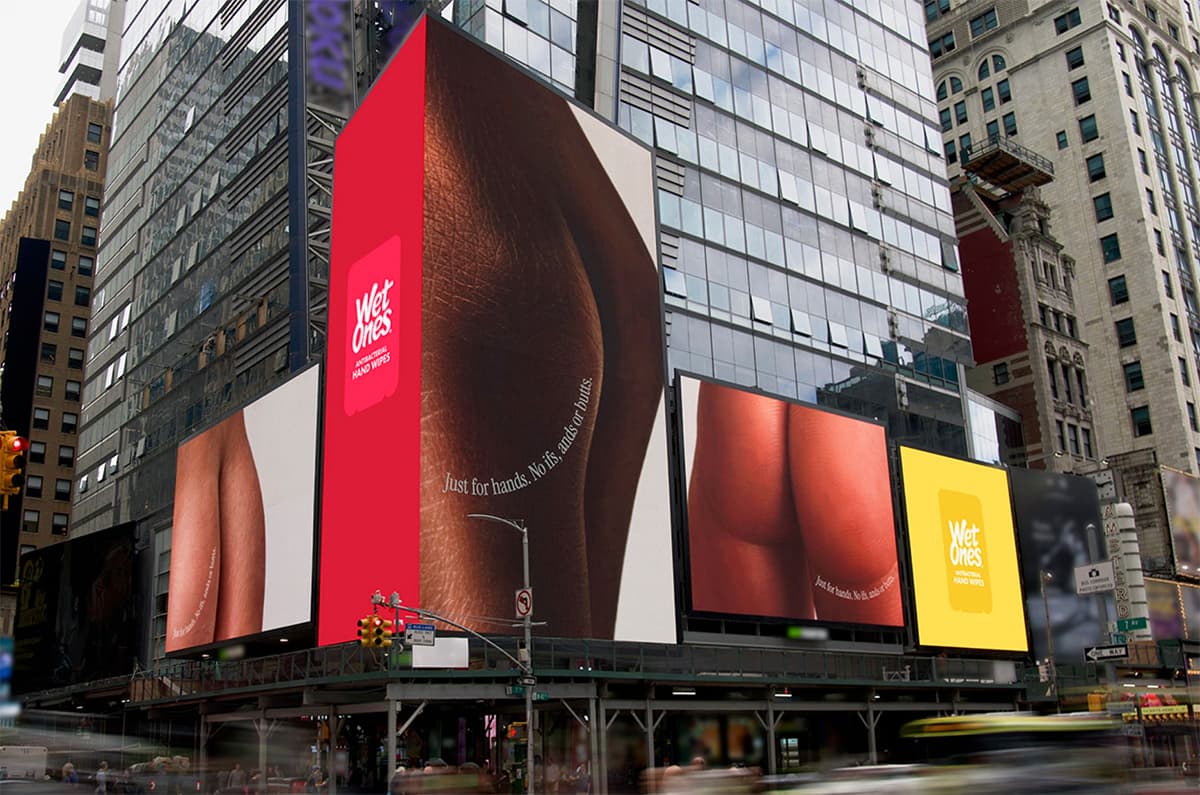
Wet Ones' New York stunt arranges hands to look like bare bottoms across the city's billboards. Transit said no to running it underground, so the brand ran it above ground instead, and made the rejection part of the story.
The TL;DR (too long; didn't read)
- BBH USA posed fingers, palms and knuckles to look like bare bottoms on street-level OOH (out-of-home advertising).
- New York City transit declined to run it underground, so it went above ground on buses, bus shelters and Times Square screens instead.
- A linked social challenge asks people to post their own 'hand butt' photos; no performance numbers have been published yet.
01
The illusion does the talking
There's no slogan to explain the joke, because the image is the joke. A passer-by needs about half a second to see the trick, and that's the whole ad.
Wet Ones ties the gag back to the product with two supporting stats from a cited OnePlus study and a water-utility cost figure, but the optical illusion is what gets the glance in the first place.
02
Turning a 'no' into coverage
Getting knocked back from the subway is normally a footnote. Here it's the headline: the brand kept the campaign alive above ground and let publications report the rejection as part of the story.
That's a cheap way to multiply reach. The media written about the ban is free distribution the brand didn't have to buy.
03
A challenge needs somewhere to go
The Instagram and TikTok 'hand butt' challenge only works if the mechanic is easy to copy with nothing but your own hands and a phone. That's the low bar that makes it spreadable.
Nothing has been published about how many people actually took part, so for now this is a strong idea to watch rather than a proven result.
Read the original reporting
The theory bit
The academic ideas that explain what's going on, with the full reference for your assignments.
STEPPS: why things catch on
Six drivers of sharing: Social currency, Triggers, Emotion, Public, Practical value and Stories. Content that makes people look good or is highly visible spreads further.
Here: The gag is built for Social currency (a funny photo to share) and is deliberately Public (billboards, bus wraps, Times Square), which is what gets it shared further.
Berger, J. (2013). Contagious: Why Things Catch On. Simon & Schuster.
Humour in advertising
Humour reliably boosts attention and liking; it works best when it's related to the product rather than a gag bolted on.
Here: The humour is directly tied to the product category (hand wipes, bottoms), which research suggests works better than a joke bolted on for its own sake.
Weinberger, M. G. & Gulas, C. S. (1992). The Impact of Humor in Advertising: A Review. Journal of Advertising, 21(4).
Over to you
No right answers here. These are to get you thinking. Jot your ideas down or chat them through.
- 1
Why might a brand be happy when a transit authority rejects its ad?
Need a nudge?
Think about what gets written about afterwards, and who pays for that coverage.
- 2
What makes the 'hand butt' challenge easy for anyone to copy?
Need a nudge?
Consider the props needed and the skill required.
- 3
What would you want to measure before calling this stunt a success?
Need a nudge?
Go beyond impressions: completion of the challenge, product trial, sentiment…
Optional · about 10 minutes
Your mini task
In 60–120 words: design a visual-illusion OOH idea for a product of your choice. Describe the illusion, where you'd place it, and one social mechanic that invites people to recreate it.