The Breakdown
Aged Care Association (NZ) · The Long Drive
239 km a day: how one number made a policy problem personal
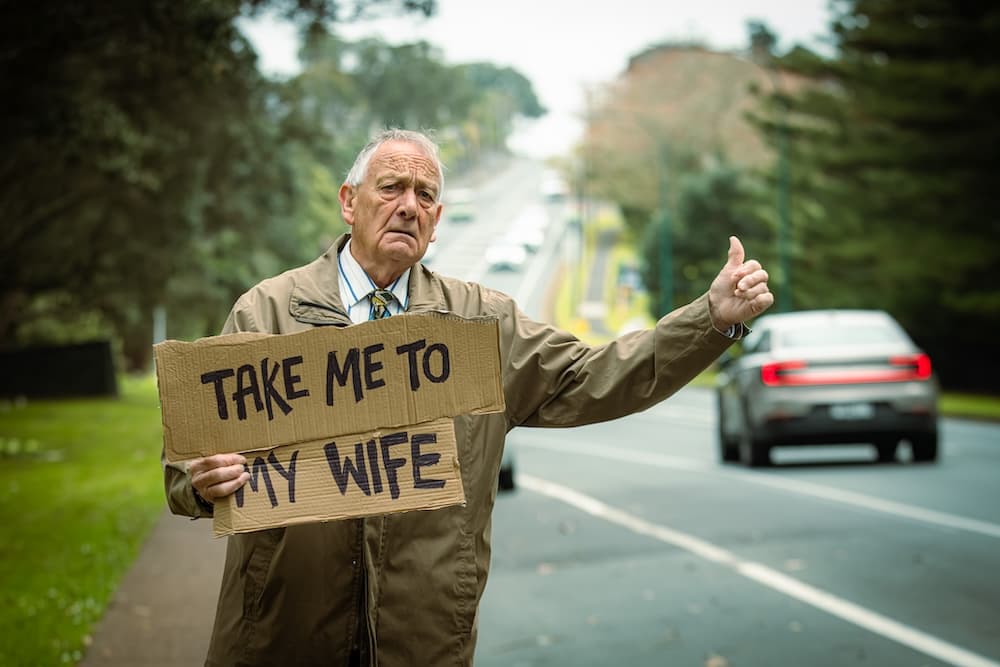
New Zealand's Aged Care Association needed people to care about facility closures. Chemistry's ‘The Long Drive’ found a husband driving 239 km a day to see his wife, and put older Kiwis on the roadside with signs.
The TL;DR (too long; didn't read)
- Older New Zealanders hitchhiked on Auckland roads with ‘Take me to my wife/husband’ signs.
- Outdoor, print, radio, digital and a landing page to email your local MP (member of parliament) (Campaign Brief).
- No results published yet.
01
One person beats a statistic
‘Facility closures’ is abstract. ‘He drives 239 km every day to see his wife’ is a story you can picture. That concrete number does the emotional work.
The hitchhiking stunt makes the distance physical and very public.
02
Emotion needs an exit
Making people feel something is only half the job. The landing page gives them something to do: email their MP. Without that, the feeling fades.
03
Who's the real audience?
The public is the channel; politicians are the target. Advocacy campaigns often work by showing decision-makers that voters care.
Read the original reporting
The theory bit
The academic ideas that explain what's going on, with the full reference for your assignments.
The identifiable victim effect
People respond more strongly to one specific, identifiable person than to statistics about many.
Here: One identifiable husband is more moving than figures about closures.
Small, D. A., Loewenstein, G. & Slovic, P. (2007). Sympathy and callousness. Organizational Behavior and Human Decision Processes, 102(2).
Made to Stick (SUCCESs)
Sticky ideas are Simple, Unexpected, Concrete, Credible, Emotional and told as Stories.
Here: ‘239 km’ is Concrete, and the roadside stunt is Unexpected and Emotional.
Heath, C. & Heath, D. (2007). Made to Stick. Random House.
Fogg Behaviour Model (B = MAP)
A behaviour happens when Motivation, Ability and a Prompt come together. Making an action easier is often more effective than adding motivation.
Here: The email-your-MP tool supplies the Prompt and Ability once Motivation is high.
Fogg, B. J. (2009). A Behavior Model for Persuasive Design. Proceedings of Persuasive '09.
Over to you
No right answers here. These are to get you thinking. Jot your ideas down or chat them through.
- 1
Why ‘239 km’ rather than ‘long distances’?
Need a nudge?
Concrete vs abstract.
- 2
Who is this campaign really trying to persuade?
Need a nudge?
Public vs politicians.
- 3
How could it fail?
Need a nudge?
Feeling exploitative, no clear ask, small reach.
Optional · about 10 minutes
Your mini task
In 60–120 words: choose a local issue you care about. Write an advocacy campaign that uses one real, specific person or number, a public stunt, and a simple action people can take.